The Legislative Council
Forty members are elected five at a time from eight regions, and every bill a government wants has to pass them. What does the published record say about how the chamber is elected, what group voting tickets did to it, and what the August 2026 change alters?
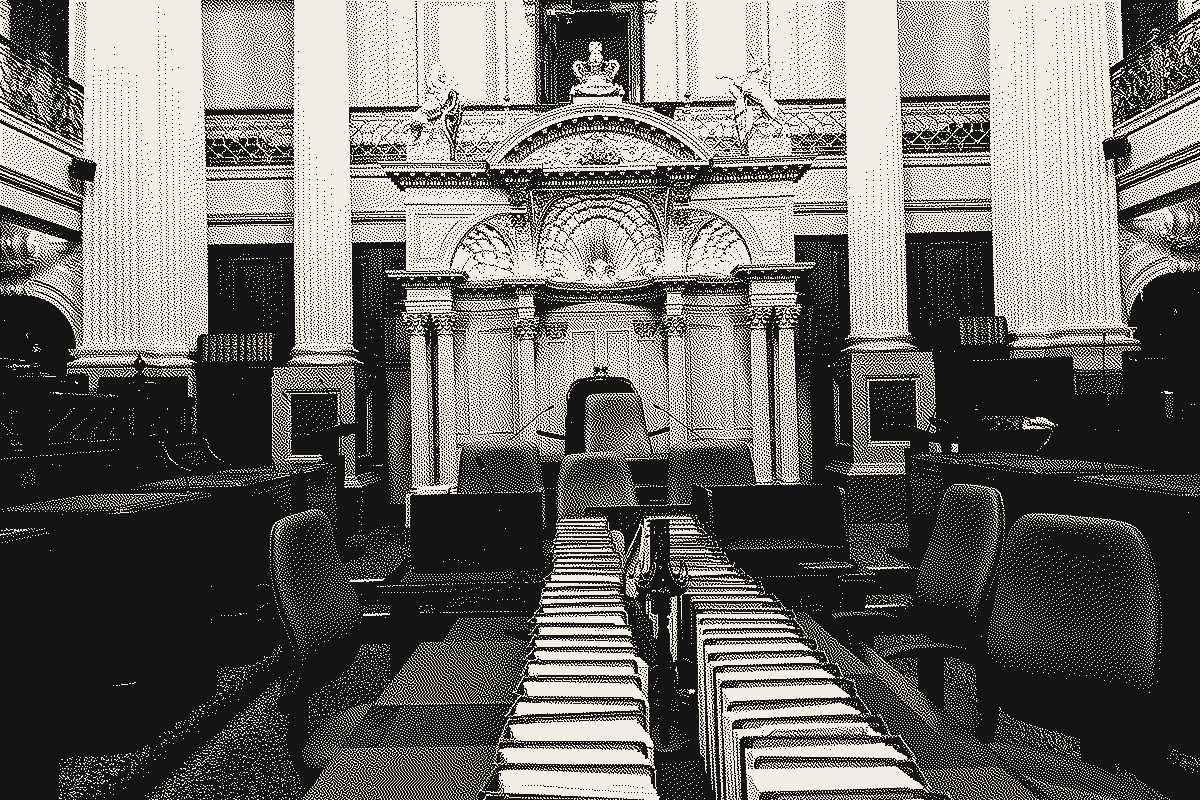
The Legislative Council chamber at Parliament House, Melbourne, where forty members sit five to a region.
The two chambers
Victoria’s Parliament has two chambers. The Legislative Assembly is 88 single-member districts, and a majority is 45 seats Wikipedia . The Legislative Council is 40 members elected five at a time from eight regions, each region spanning 11 Assembly districts, by a proportional count with a quota of one-sixth of the formal vote Parliament . A majority there is 21.
The Council can’t block supply. That power was removed in the 2003 reform, the Constitution (Parliamentary Reform) Act 2003, which also introduced the proportional system and the regions used since 2006 Wikipedia . Every other bill still has to pass it. So a government can see its programme held up in a chamber it doesn’t control. A government elected with an Assembly majority can still have to negotiate each bill through a Council where it is a minority Guardian .
What group voting tickets did
Group voting tickets came in with the 2003 reform, to make voting simpler and cut informal ballots Parliament . From the 2006 election, an upper-house voter could mark a single “1” above the line for a party. Every preference after that was allocated by the order the party had lodged, a ticket the voter never saw Parliament . The voter gave up control of their own preferences to the party they numbered first.
That arrangement produced a market in preferences. Brokers assembled ideologically unrelated microparties into reciprocal tickets. The brief names Glenn Druery’s preference whispering among the controversy that led to two inquiries recommending abolition Parliament . The arrangements themselves directed preferences between parties with little in common otherwise Wikipedia . Victoria was the last jurisdiction in the country still using the system: New South Wales abolished it in 1999, the Senate in 2016, South Australia in 2017 and Western Australia in 2021 Parliament .
| Election | Region | Ratio | Leader’s vote | Winner’s vote | Winner |
|---|---|---|---|---|---|
| 2018 | Eastern Metropolitan | 14.52 | Greens 9.00% | 0.62% | Transport Matters |
| 2018 | South-Eastern Metropolitan | 14.64 | Liberal 12.30% | 0.84% | Liberal Democrats |
| 2018 | Southern Metropolitan | 10.20 | Greens 13.46% | 1.32% | Sustainable Australia |
| 2022 | Northern Victoria | 3.27 | Labor 12.18% | 3.72% | One Nation |
| 2022 | Northern Victoria | 4.47 | Greens 6.97% | 1.56% | Animal Justice |
| 2022 | South-Eastern Metropolitan | 1.92 | Liberal 10.10% | 5.25% | Legalise Cannabis |
Antony Green’s ratio measure divides the leading candidate’s vote by the trailing winner’s. It reached 23 in the 2013 Victorian Senate contest and 51 in Western Australia in 2021 (without group voting tickets it rarely exceeds 1.5) A. Green . Across 2014, 2018 and 2022, 24 candidates who began above 6% were defeated by candidates polling less than they did. A further 20 were elected from under 6%, nine of them from under 3% A. Green .
What the 2026 Act changed
The Electoral Amendment (Miscellaneous Matters) Bill 2026 was introduced in the Assembly by Anthony Carbines on 28 July 2026 and deemed urgent. It passed the lower house the next day without amendment. It went to the Council on 30 July, where Ingrid Stitt led for the government, and passed 33 votes to four on the night of 11 August. Royal assent came on 18 August and the change took effect on 19 August, the day after assent Parliament Wikipedia .
The 33 votes in favour were Labor 15, Liberal 11, Greens 4, Nationals 2 and One Nation 1 — three members were absent or abstained Wikipedia . Both major parties and the Greens voted for the change. The four votes against came from the four members whose parties had been built on the system being abolished Guardian .
- Georgie Purcell, Animal Justice, who said the change would “significantly decrease” her chances of re-election and that “it’s not over until it’s over”. Guardian
- Rachel Payne, Legalise Cannabis, who said she would run again. Guardian
- David Limbrick, Libertarian, who also committed to running again. Guardian
- Jeff Bourman, Shooters, Fishers and Farmers. Guardian
From this election, an above-the-line voter must number at least five groups in order of preference, and a below-the-line voter at least five candidates. The only between-party preferences that count are the ones the voter writes. A “1” for a group flows to that group’s lead candidate and then to its remaining candidates in ballot order, so the voter doesn’t set the order within a group Parliament . Saving provisions adopted from the Senate keep a ballot formal where a voter numbers fewer than five but marks a valid first preference. A cross or a tick in a square counts as a “1”, and a ballot marked on both sides is taken as below-the-line only Parliament .
What did not change matters as much. The eight regions, the five members per region and the 16.7% Droop quota are untouched Parliament . Altering the region structure would require a referendum, which a parliamentary inquiry recommended for 2028 or 2030 but which was not part of this Act Guardian .
The quota
In a five-member region the quota is one-sixth of the formal vote, 16.7%. Seats fall at multiples of it: 16.7% for one, 33.3% for two, 50% for three, 66.7% for four and 83.3% for five A. Green . Above 16.7% a party wins a seat. Below it, under the new system, it is very unlikely to A. Green . The fifth seat in each region is the hinge. Green expects the Coalition to win two seats in every region and Labor one or two, which leaves that last seat to decide who holds the balance of power Guardian .
| Seats won | Share of the vote |
|---|---|
| 1 | 16.7% |
| 2 | 33.3% |
| 3 | 50.0% |
| 4 | 66.7% |
| 5 | 83.3% |
What a re-run of past counts suggests
Green applied the new rules retrospectively to 2014, 2018 and 2022. He finds 5, 7 and 6 fewer minor-party members respectively. In 2014 that is one Labor member fewer along with two Coalition and two Greens. In 2018 it is one Labor, three Coalition and three Greens, and in 2022 one Labor, one Coalition and four Greens. Across the three elections, non-Green minor-party seats would have fallen from 22 to 4, with the Greens rising from 10 to 19, Labor from 47 to 50 and the Coalition from 41 to 47 A. Green .
5 in 2014, 7 in 2018, 6 in 2022
| Election | Count | ALP | L/NP | GRN | Others |
|---|---|---|---|---|---|
| 2006 | Actual | 19 | 17 | 3 | 1 |
| 2006 | No GVTs | 20 | 17 | 3 | — |
| 2010 | Actual | 16 | 21 | 3 | — |
| 2010 | No GVTs | 16 | 21 | 3 | — |
| 2014 | Actual | 14 | 16 | 5 | 5 |
| 2014 | No GVTs | 15 | 18 | 7 | — |
| 2018 | Actual | 18 | 11 | 1 | 10 |
| 2018 | No GVTs | 19 | 14 | 4 | 3 |
| 2022 | Actual | 15 | 14 | 4 | 7 |
| 2022 | No GVTs | 16 | 15 | 8 | 1 |
What it is likely to produce
On statewide polling, Green expects the Coalition to win about two seats in each region, roughly 16 in all. He has Labor on one or two per region, so roughly 10 to 12 seats. He gives the Greens up to six, one in every metropolitan region and possibly one regional, and One Nation eight or nine Guardian . One Nation’s polling already had it on track for at least eight seats even with the old system in place ABC . If the Liberal Party forms government after the election, even with an Assembly majority, it won’t have a majority in the Council and will have to rely on One Nation there Guardian .
That flips the usual crossbench dynamic. A Coalition on about 16 seats plus One Nation on eight or nine reaches 24 or 25, past the 21 votes a majority of 40 requires. Labor on 10 to 12 plus the Greens on up to six falls short of it on those numbers Guardian . One Nation is the only party that stands to gain from the reform. Its rise came on first-preference votes, and Green’s view is that it would elect a substantial bloc with or without the tickets Guardian .
The microparties are the other half of the story. Animal Justice, Legalise Cannabis, the Libertarian Party, Shooters, Fishers and Farmers and the Democratic Labour Party all held seats built on preference harvesting at 16.7% quotas. Those members said they supported abolition, but only next to a structural reform that scrapped the eight regions for a single statewide electorate. That would cut the effective quota to about 2.4% and would need a referendum. It was not in the Act Guardian .
The estimates are wide because they read party polling rather than simulate seats. Green puts One Nation at seven or eight and the Greens at four or five A. Green . Glenn Druery, the preference broker the reports name, has said the new system could win One Nation as many as 16 seats and leave the Liberals as few as eight ABC . The election is on 28 November 2026 Wikipedia , so none of these figures is a count.
Summary
- On the published expectations, no party wins a Council majority on its own, so the chamber’s business gets negotiated bill by bill Guardian .
- One Nation is the likely holder or co-holder of the balance of power: eight or nine seats on Green’s read, as many as 16 on Druery’s Guardian ABC .
- The microparty crossbench as it stood after 2022 can’t be recovered at a 16.7% quota, because those seats depended on tickets that voters no longer delegate A. Green .
- Treat the per-region figures as estimates from party-level polling, not counts: the election is on 28 November 2026 and no vote has been cast under the new system Wikipedia .
Parliament of Victoria, Bill Brief No. 6
The Parliamentary Library’s brief on the Electoral Amendment (Miscellaneous Matters) Bill 2026: where group voting tickets came from, what the Bill repeals, and what it puts in their place.
“GVTs were introduced in Victoria in 2003 to simplify voting and reduce informal ballots, allowing a single above-the-line vote with preferences distributed per party-registered tickets.”
The origin of the system the Bill removes.
“The Bill repeals the GVT provisions and requires voters to number at least five groups above the line (or five candidates below the line).”
The operative change.
“Below-the-line voting 2022 rose from 7.05% to 9.4%.”
How many voters were already choosing candidates rather than groups.
- The brief is written from the Bill’s text and the second-reading debate, not from a count. It describes what the Act requires, but it can’t say what the requirement produces at an election.
- The brief records the Electoral Matters Committee’s two-stage recommendation: abolish the tickets before 2026, and consider structural change through a referendum in 2028 or 2030. Only the first stage became law.
- The VEC told the inquiry that the weighted inclusive Gregory method it recommended was too late to introduce safely for the 2026 election. The brief doesn’t say which method the 2026 count will use.
Antony Green, ABC
Antony Green’s analysis of how group voting tickets distorted Council results, measured against a re-run of the 2006 to 2022 counts under the new rules.
“The change favours parties that campaign for votes over parties that rely on preferences.”
Green’s one-line reading of the reform.
“Based on post-GVT Senate results, weaker preference flows will make it very difficult for a party to be elected with less than 6% in a region.”
The threshold the Senate’s experience suggests.
“GVTs were used to block the Greens from hinge seats; without GVTs the Greens would likely have held the upper-house balance of power alone since 2014.”
Why the fifth seat in each region carries the chamber.
“I'd expect One Nation to win 7-8 seats, maybe more if its vote is high enough to win two seats in any region. I'd expect there to be 4-5 Greens.”
His expectation for 2026, given in reply to a comment on the post.
“The abolition of GVTs means MLCs will all come from Labor, Liberal, National, Greens and One Nation.”
What he expects the crossbench to be made of.
- The counterfactuals are re-runs of past counts under the new rules, not observations of an election held under them. They assume the same votes were cast and only the count changed, which isolates the tickets but not the campaign that produced those votes.
- The 2026 expectation is a party-level read of the polls, given in reply to a comment rather than as a model. Green gives ranges for each party and publishes no seat-by-seat projection.
The Guardian
The Guardian’s report the day after the Council vote, on the four members who opposed it and on what the change is expected to do to the chamber’s shape.
“This reform is about converting the electoral system into one that rewards parties that get votes over parties who, in the past, have been elected by clever preference deals... In the last decade we've had about 20 candidates elected with under 6% of the vote – some as low as 1%... That is impossible under a system where voters control their own preferences.”
Green’s case for the change, as reported.
“Whatever happens, if the Liberal party form government after the election, even with a majority, they will not have a majority in the upper house. They will have to rely on One Nation in the upper house.”
What the reform does to a new government’s position in the Council.
“going to have a lot of trouble getting someone elected with this new system”
On the four parties whose members voted against.
- The report was written before nominations closed and before any vote was cast under the new system. Its seat numbers are Green’s expectations from statewide polling, reported as a range rather than a projection table.
- The four members who voted against are named. The report doesn’t say how the other 33 voted, which the third-reading breakdown elsewhere in the record does.
Linked notes
- PollingVictoria is a three-cornered contest that ends in a two-party result. The 28 published polls of 2026, the four averages, the six seat models, and the preference flow nobody has measured seat by seat.
- Who funds the rightTwo registers read as data rather than as reporting: the federal 2024-25 disclosures and every Victorian donation since 2020, for both parties of the right. One Nation itemises a fifth of what it receives and takes almost no corporate money; the Liberals take most of theirs through investment vehicles whose own donors the return never names.