Who funds the right
The Liberal and One Nation parties both present themselves as the parties of ordinary Australians. Both federal and Victorian registers record where their money actually comes from — so what do they show, and how do the two compare?
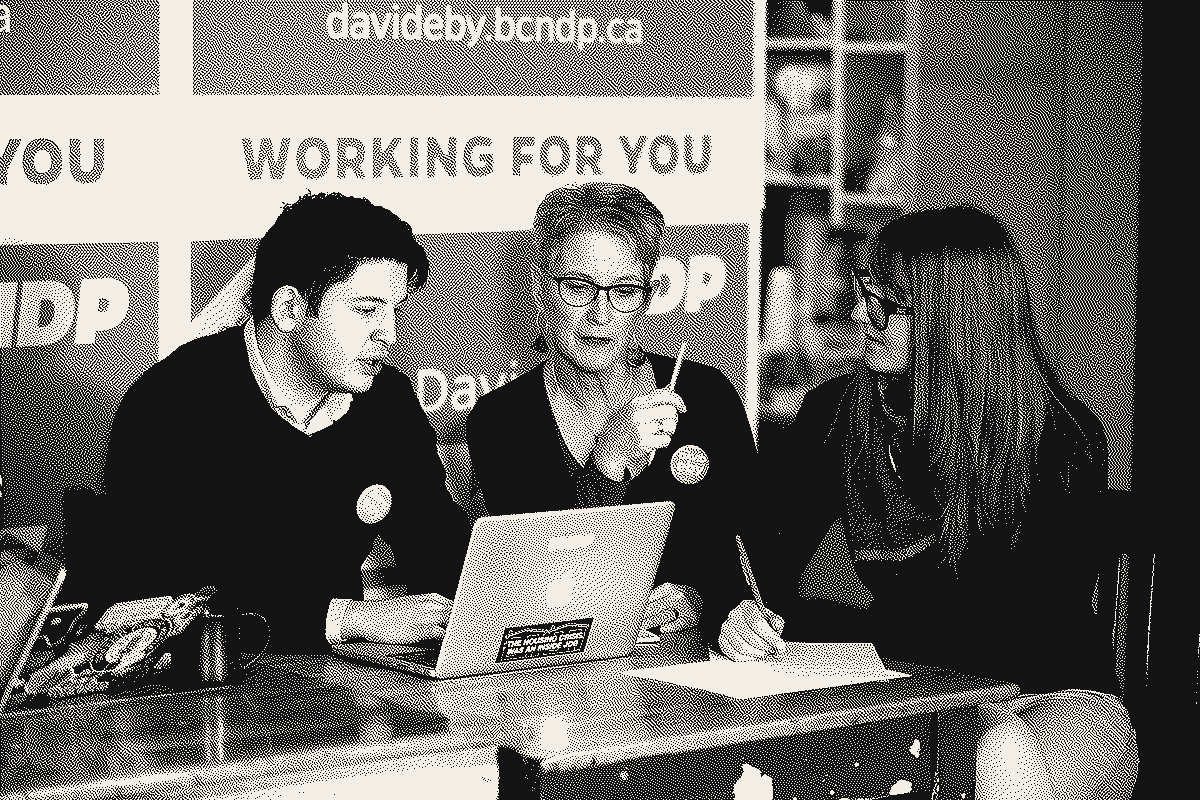
Volunteers working a campaign office, with party signs stacked behind them.
Where the right's money comes from
Each party gets two panels, because there are two registers. Federal receipts are reported to the Australian Electoral Commission; state donations to the Victorian Electoral Commission. Victorian law forbids spending federal money on a state campaign, so the panels are separate flows, and each panel is scaled to its own box.
One Nation
One Nation, source by source. Each named payer is on the left; the kind of money it is sits in the middle; the party on the right.
The federal panel’s largest band is not a donor. It is $2.599m — 78% of receipts — arriving below the $16,900 threshold, which is why it has no name. Of what is named: $345k from the leader and her senators (of which $245k is Hanson’s own money), $277.7k from six named donors and the hotels association, $81.9k public funding, and $19.7k the Victorian branch passed up.
The Victorian branch is a separate flow and a smaller one. Its 2026 donations are $85,268 from 28 payers — 22 individuals, three companies and three gambling or hotel bodies, the last arriving in three weeks of August and September after three years of nothing.
- Itemised and named
- Not itemised, or named and unverifiable
- Public funding
- Gambling and hotels
Liberals
Liberals, source by source. Each named payer is on the left; the kind of money it is sits in the middle; the party on the right.
The federal party is funded mostly by the taxpayer: $30.87m of its $53.2m in receipts is electoral-commission money, departmental funding and tax refunds. Named donors are $14.5m, and the largest single payer is not a donor at all — the Australian Electoral Commission at $26.8m.
The Victorian division is the sharper picture. $13.9m of its $32.15m is below the disclosure threshold and unnamed, and another $7.78m arrives through three investment vehicles — Cormack ($4.70m), Vapold ($2.64m) and Higgins ($300k) — whose own donors the party return never lists. Only $2.52m is disclosed as ordinary donations.
- Itemised and named
- Not itemised, or named and unverifiable
- Public funding
Two public registers record this money and they measure different things. The Australian Electoral Commission publishes annual returns; the Victorian Electoral Commission publishes a live register of individual donations. The federal threshold is $16,900, so most donations never appear in it. The Victorian threshold is $1,290, so nearly everything does AEC VEC .
The two are not additive. Federal money may not be used for a Victorian state campaign, and the registers cover different electoral purposes. They are read side by side here because each shows something the other cannot.
The disclosure gap is the finding
A party’s total receipts are not its donations. Receipts include public funding, interest, ATO refunds, transfers between branches and payments for services. Only the part above the threshold is itemised, and the share that is itemised is the measure of how much the register can tell you AEC .
| Party | Total receipts | Itemised above threshold | Itemised share | Declared gifts | Donors |
|---|---|---|---|---|---|
| Labor | $71.86m | $68.54m | 95.4% | $9.57m | 121 |
| Liberals | $53.23m | $46.45m | 87.3% | $13.23m | 165 |
| Nationals | $4.15m | $3.21m | 77.3% | $1.41m | 57 |
| Greens | $9.30m | $5.33m | 57.4% | $1.83m | 15 |
| One Nation | $3.32m | $0.70m | 21.0% | $0.18m | 5 |
One Nation itemises a fifth of what it receives. The other 79%, $2.63m, arrives below the threshold and is reported only as a total. The party is not funded by a handful of companies; it is funded by a very large number of small payments, and the register is built so that none of them appear AEC .
The largest donor in the country is a foundation
Cormack Foundation Pty Ltd is a Liberal-aligned investment company. It received $11.81m in 2024-25 and paid out $10.13m, including $4.7m to the Liberal Party’s Victorian division. That single line is 14.6% of the division’s $32.15m in receipts AEC .
Cormack’s own inflows are the corporate register the parties never publish: $7.09m from Finclear Services, $1.24m from the Commonwealth Bank, $615k from NAB, $556k from Wesfarmers, $538k from Rio Tinto, $380k from BHP, $256k from Transurban, $190k from Coles, $114k from Westpac, $68k from Woolworths and $41k from Woodside. Every one is booked as an other receipt of an investment company AEC .
Victoria has a matching pair: Vapold Pty Ltd, $4.22m in receipts of which $3.1m came from Credit Suisse, and the Higgins Foundation at $680k. Labor’s equivalent is Labor Services & Holding Pty Ltd, with $6.86m in receipts AEC .
Victoria has no sector bans
The Electoral Act 2002 prohibits exactly two kinds of donation: foreign money and anonymous gifts at or above the threshold. There is no ban on property developers, tobacco, gambling or liquor. The ACT bans developer donations; Victoria does not VEC .
The register shows what that permits. Sportsbet gave $2,000 and Responsible Wagering Australia gave $2,000 to One Nation Victoria within a day of each other in late August 2026, and the Australian Hotels Association gave $2,000 in September and $4,000 in August VEC .
One Nation’s Victorian record stops for three years
The party disclosed $7,101 in eight small gifts around the 2022 state election. It then disclosed nothing at all until 10 January 2026. Everything since is $85,268 from 28 donors, and its first corporate money in four years arrived in the same three weeks as the gambling donations VEC .
The individuals behind those donations are mostly small givers, and several are the party’s own people. Six of the 22 dated individual donors are One Nation candidates — John O’Connor (Ringwood, $5,000), Michael Piastrino (Berwick, $3,000), Peter Angelico (Hastings, $2,000), Jeremy Johnson (Yan Yean, $1,269) — and the undated rows include the state leader Warren Pickering, the party’s only Victorian MP Rikki-Lee Tyrrell, and the Morwell and Nepean candidates. Matchable by name, the party’s candidates and officers account for $18,880 of the $134,805 it has disclosed since 2020 VEC .
No individual gift exceeds $5,000, which is the cap; the median is $2,000 and twelve of the 22 individuals gave $2,000 or less. There is no Victorian equivalent of the $1m and $500,000 federal gifts. The donors with outside prominence are few and each gave small: Christopher Flipo of Kew gave $4,000 here and $4,000 to Advance Australia; Tom Francis gave to Labor and the Nationals as well; Rod Fenwick gave to the Liberals as well VEC .
| Party | Total | Donors | Median gift | Largest gift |
|---|---|---|---|---|
| ALP Victorian Branch | $2.18m | 631 | $1,719 | $40,000 |
| Liberal Victorian Division | $1.42m | 382 | $3,000 | $5,190 |
| Greens Victoria | $0.43m | 142 | $1,500 | $5,030 |
| Nationals Victoria | $0.21m | 74 | $2,200 | $5,030 |
| One Nation Victoria | $0.09m | 28 | $2,000 | $5,000 |
| Victorian Socialists | $0.02m | 10 | $1,500 | $5,190 |
The cap has changed the shape of giving
From 1 July 2026 the general cap is $5,190 and the disclosure threshold $1,290. Of 1,034 donations dated on or after that date, 222 sit at exactly $4,990 to $5,190. The median donation in the first three months of 2026, before the cap, was $2,500 VEC .
Twenty-five donations exceed it. Four go to the Victorian ALP, eight are candidate self-donations, and the rest are $10,380 gifts to teal-aligned independents under the doubled new entrant cap VEC .
Two parties, two shapes of money
The two are funded in opposite ways, and the difference is the point. The Liberals’ federal party takes $30.9m of public money and $14.5m from named donors, and its Victorian division routes $7.78m through three investment vehicles whose own contributors never appear on the party return. One Nation takes $81,880 of public money federally and $177,671 from five named donors, and two thirds of its receipts are payments too small to itemise AEC .
Neither is more transparent than the other; they are opaque in different places. The Liberals’ opacity is institutional — a chain of foundations, each of which files its own return. One Nation’s is arithmetic — a very large number of small payments no register can resolve. Only the second is visible in the party’s own filing, which is why the chart for one shows a single hatched block and the chart for the other shows a band labelled Cormack AEC .
On the state side the comparison is starker. Victoria’s Liberals had $32.15m in receipts to One Nation’s $127,704 — 250 times the money. But One Nation’s $85,268 of 2026 donations came from 28 payers including six of its own candidates, while the Liberals’ $10.3m of itemised donations came from 44 entities with a median individual gift of $2,500. One is a candidate self-funding scheme; the other is a donor base VEC VEC .
Where the ideological money actually sits
Coal Australia Limited gave $5.39m in 2024-25. It gave $5.15m to three advocacy vehicles, $131,000 to the Nationals, $84,500 to the LNP, $10,000 to the Liberals and $14,150 split across four Labor branches. It gave One Nation nothing. The ratio of campaign vehicle to party funding is 21.5 to 1 AEC .
Climate 200 is the mirror image, with $14.89m in gifts dispersed to teal campaigns and its own vehicles. The symmetry is real but not equal: $52.89m from Mineralogy Pty Ltd to Trumpet of Patriots exceeds the entire Climate 200 operation threefold AEC .
The party registers miss most of this money. A third-party campaigner reports its own receipts and its own electoral expenditure, and the three largest conservative vehicles in 2024-25 spent $14.3m on electoral communication between them — more than the Liberals’ and One Nation’s declared gifts combined AEC .
| Vehicle | Receipts | Electoral expenditure | Share itemised | Largest funder |
|---|---|---|---|---|
| Advance Australia | $13.46m | $10.11m | 39% | Hancock Prospecting, $895,000 |
| Australians for Prosperity | $3.89m | $2.84m | 95% | Coal Australia, $2.74m |
| Jobs for Mining Communities | $2.36m | $1.38m | 100% | Coal Australia, 100% |
| Energy for Australians | $1.08m | $0.80m | 100% | Coal Australia, 100% |
| Better Australia 2025 | $1.31m | $1.26m | 0% | No itemised receipts |
| Australian Christian Lobby | $6.75m | $0.56m | 1% | MacCulloch, $70,000 |
Advance Australia is the biggest of them, and the least visible where it matters. It spent $10.11m on electoral communication — 75% of everything it took in — and itemised $5.27m of $13.46m in receipts. The year before, 91% of its itemised money, $11.89m, arrived from one entity, Australians for Unity Ltd, booked as an other receipt rather than a donation AEC . That entity files no return of its own and appears in no year of the federal donor file.
The coal money is more legible, because one company declares it: the three vehicles Coal Australia funds itemise between 95% and 100% of their receipts, and the payer is the same name in all three AEC . A single funder is easy to name. The vehicles the left runs are not more transparent, they are differently opaque. Climate 200 itemises 63% of $23.6m, all of it booked as donations, so its 75 funders are named. The ACTU itemises $29.10m and none of it is a donation — departmental funding and union transfers booked as other receipts — so the union movement’s money appears in the donor file almost nowhere. GetUp itemises 19% AEC . The measure that matters is not how much is itemised but whether the itemised rows carry a name.
Victoria’s version is smaller and harder to see
Federal vehicles must register, so they file. A Victorian group that advertises without naming a party or candidate does not have to, unless it runs the ads during the campaign period Guardian . Fix Victoria spent just under $100,000 on Google and Meta advertising in August 2026 — about a quarter of all election-related advertising that month — and Better Victoria about $40,000, both outspending the Liberals, the teal independents and One Nation on social media Guardian .
On 30 September Fix Victoria pulled its ads and went dark. Its own legal advice was that continuing into the campaign period would make it a third-party campaigner, subject to the $5,030 cap and disclosure above $1,250 — so it stopped advertising rather than disclose The Age . The organisation’s membership, about 30 people, and its funding are not public, and its founders declined to say whether Cormack money reached it The Age .
That is the asymmetry in one state election. A union or a climate group that registers gives its funders’ names, because its money is booked as donations. A conservative group that stays under the registration threshold keeps its funders private and spends in the weeks when disclosure would begin. The state register shows $35,593 to Advance Australia’s Victorian arm and $6,500 to the Australian Christian Lobby in the current cycle; it shows nothing at all for Fix Victoria or Better Victoria, because neither is in it VEC .
What it means for the next five years
None of this donor money is the main event. One Nation stands to receive $219m in public funding over five cycles under the new $5-a-vote rate, against the $6.08m it banked in 2025 The Saturday Paper . Corporate backing is start-up capital for a party that will be funded by the taxpayer once it converts its polling into votes.
The disclosure rules change on 1 January 2027: the threshold falls to $5,000 and private donations are capped at $50,000 per donor per recipient per year The Saturday Paper . The current returns are the last that will be this opaque, and One Nation’s 2025-26 return is not published until 1 February 2027.
Summary
- One Nation itemises 21% of its federal receipts, against 95% for Labor and 87% for the Liberals. It takes almost no sector money; it is funded by small payments that never reach the register AEC .
- The Liberals’ federal party is funded mostly by the taxpayer: $30.9m of $53.2m is electoral-commission money, departmental funding and tax refunds AEC .
- The Liberals’ Victorian division takes $7.78m through three investment vehicles — Cormack, Vapold and Higgins — whose own donors the party return never names. Cormack alone is $4.70m, 14.6% of the division’s receipts AEC .
- Victoria bans only foreign and anonymous donations. Sportsbet, Responsible Wagering Australia and the hotels association all gave to One Nation Victoria within three weeks in August–September 2026, after three years of nothing VEC .
- Public funding dwarfs the donations for both parties: $219m is projected to One Nation over five cycles under the $5-a-vote rate The Saturday Paper .
- The conservative campaign vehicles spent $14.3m on electoral communication in 2024-25 while itemising between 0% and 95% of their receipts; Advance Australia’s 2023-24 money arrived 91% from a single entity that files no return AEC .
Linked notes
- One Nation policy recordOne Nation Victoria launched a 64-page platform on 3 October with no dollar figure for any spending commitment. Its crime package would expand police powers, build three courts and return the age of criminal responsibility to 10. Payroll tax and sport vouchers each carry two different versions across the campaign.
- Integrity and Anti CorruptionGeoffrey Watson SC’s report for Mark Irving KC, the CFMEU administrator, called the union’s Victorian branch a crime syndicate. It costed the branch’s conduct at up to $15bn, roughly 15% of the $100bn Big Build, and Irving removed the chapters behind that figure before publication. The royal commission that could test it reports after the election, and IBAC has warned every party about donations, lobbying and privileged access in the campaign.
- Preference flowsWhat a preference flow is, the counted estimates for Australian elections, and what the polling and seat models assume about moving one.
- Attention to the far rightStudies on whether attention to immigration, or to the party, raises far-right support, and on which counter-messages have moved it.
- Correcting false claimsThe experiments on whether correcting a false claim changes what people believe, and what a correction needs before it works.
- Evidence for campaign tacticsThe designs that can carry a claim that a tactic worked, the kinds of account that can’t, and how the published record is tilted.
- PersuasionThe field experiments on whether campaign contact changes a vote, and where the effect has shown up.