A WhatsApp channel and a Brazilian comeback
Lula won Brazil’s runoff three weeks after finishing second in the first round. Over those three weeks ten million more people voted for him than had before, and his campaign’s most visible instrument was a broadcast channel on WhatsApp. Did the channel do that?
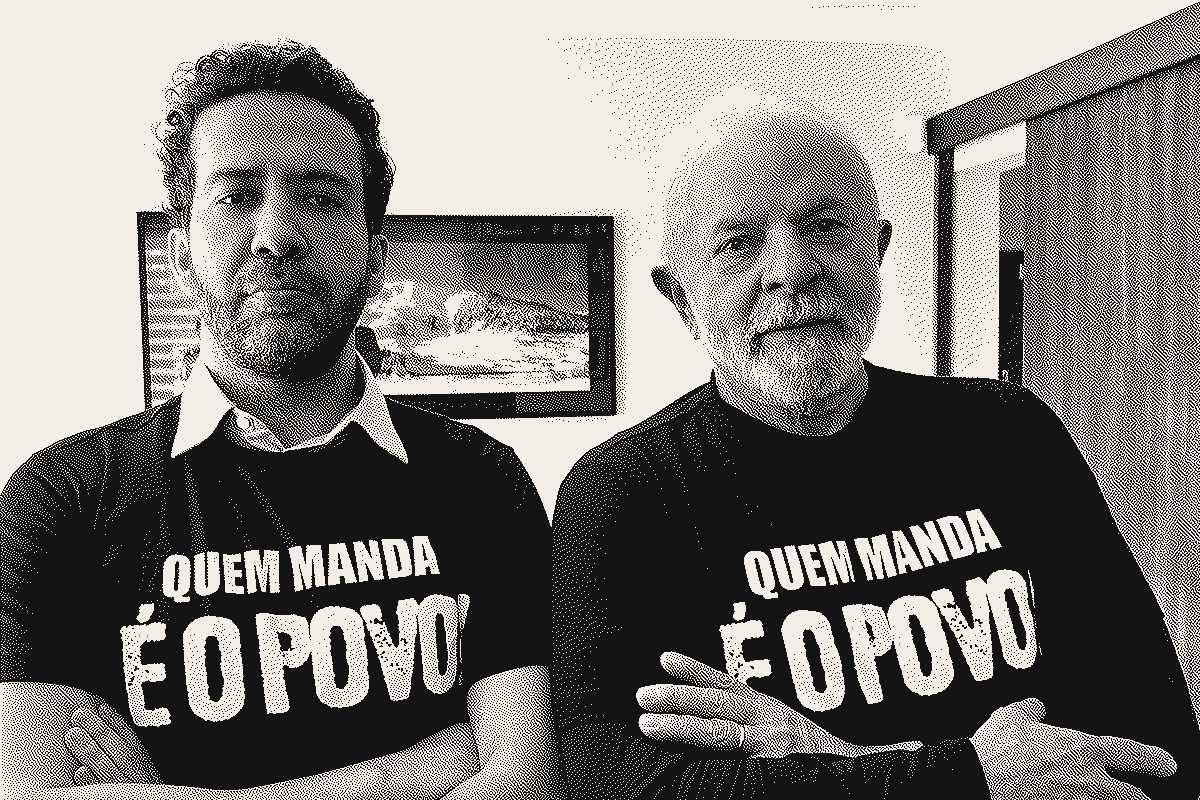
Lula and the deputy André Janones during a 2022 live broadcast. Janones ran the channel Exército do Lula through the 2026 runoff.
Summary
- Both candidates won more votes in the runoff than in the first round. Lula gained 10.4 million and Flávio Bolsonaro gained 3.7 million, so Lula’s increase was nearly three times the size of his opponent’s. It happened in a round where abstention fell and 9.1 million votes cast for eliminated candidates had to go somewhere. That is a question about who gained more, not about whose voters changed sides.
- Most of Lula’s gain came from the Southeast, where he lost. He added 4.8 million votes there against 2.96 million in the Northeast, where he won nearly seven votes in ten. The Northeast gave him his biggest lead, which is a different thing from his biggest increase.
- The channel grew fastest while courts were trying to shut it down, not during campaign events. Two of its steepest jumps came within days of the electoral court suspending it, and its operator claimed half a million new followers after the first suspension.
- Nobody has measured how many votes the channel won. Every political scientist quoted in the coverage says the result can’t be attributed to it, and the newsrooms say as much themselves. The claims that it decided the election come from the people who ran it.
- The campaign was suing Meta in the same weeks it ran its most effective operation on a Meta product. Paid advertising was the only way to reach people at that scale, because the electoral court bans platforms from recommending candidate accounts. That bind is the part of this story that repeats here.
Tribunal Superior Eleitoral, 2026 results
The official two-round counts. Lula took 51.79% of valid votes in the runoff after finishing second in the first round by 2.2 million votes.
- First round, 4 October: Flávio Bolsonaro 56,104,503 (47.03%), Lula 53,879,538 (45.16%). Runoff, 25 October: Lula 64,256,232 (51.79%), Flávio 59,826,041 (48.21%).
- Lula gained 10,376,694 votes between rounds and Flávio gained 3,721,538. The 9.1 million votes cast in the first round for candidates who were eliminated had to go to one of these two, along with most of the people who had abstained or spoiled a ballot.
- Abstention fell from 21.08% to 19.21%, the lowest in a presidential election since 2006. Blank votes fell from 2.93% to 1.12%; null votes rose from 1.84% to 2.12%.
- The first-round gap was the narrowest since the return to democracy: 2,224,965 votes. The runoff gap was 4,430,191.
G1, vote change by region
A municipality-by-municipality comparison of how many votes each candidate won in each round. Lula gained most in the Southeast, where he still lost.
- Lula gained 4.8 million votes in the Southeast, from 19.2 million to 24.0 million, and Flávio gained 1.9 million there. The senator’s regional lead fell from about 5.7 million to 2.8 million.
- The Northeast added 2,955,848 votes to Lula and 397,763 to Flávio. The South added 1,332,846 and 866,745, the Centre-West 770,876 and 470,431, the North 474,024 and 14,110.
- São Paulo was the state where both gained most: Lula 2.6 million, Flávio 1.2 million, with the senator’s lead falling from 3.4 million to 2.0 million.
- Flávio took fewer votes in the second round in six states and 937 municipalities, and lost votes in two capitals, Macapá and Boa Vista. Lula gained in all 26 states, the Federal District and all 27 capitals.
G1, where each candidate’s votes came from
How each candidate’s total was spread across the five regions. It answers two different questions that get run together: how much of a region he won, and how much of his own vote came from it.
- Lula’s votes split almost evenly between the Northeast (24,450,432, 38.17%) and the Southeast (24,037,731, 37.53%). Flávio’s came mostly from the Southeast (26,844,501, 45.00%), then the South (11,385,893, 19.09%).
- Within regions, Lula took 69.37% in the Northeast and 47.24% in the Southeast, where Flávio took 52.76%. The North was the closest region at 50.01% to 49.99%.
- These are two different measurements and commentary runs them together. A region can be a candidate’s largest single source of votes while he loses it, which is what the Southeast was for Lula.
Poder360, follower counts
The subscriber count read off the channel page at intervals through the final week, with the newsroom’s own caveat that the figure is reach and not participation.
- The count sat at 6 million followers on the evening of 20 October. It passed 7 million by 09h59 the next morning, more than a million gained in 13 hours 40 minutes.
- On 18 October, during a televised debate, Janones sent members to search for negative terms about his opponent. The terms appeared among that evening’s search trends.
- The article states the limit itself: the follower count does not establish how many members took part in the actions the channel called for.
BBC News Brasil, the court’s report
The electoral court’s disinformation unit found none of the claims Flávio’s campaign attributed to the channel in the ten days before the complaint. It also described a coordinated operation that grew from 55,000 to 3.3 million in six days.
- The report examined posts from 2 to 11 October and found no reproductions of the statements in the case file. It noted that September posts named in the complaint fell outside the window and could have been edited or deleted first.
- It described activity that was coordinated, centralised and synchronised, aimed at widening the circulation of content on WhatsApp and elsewhere, and a style built on military and polarising language.
- After the channel was restored, its operator wrote that it had gained 500,000 new followers since the suspension and urged members to keep inviting people.
- Three orders in three days: a complaint filed on 7 October, a 72-hour deadline for clarification, then a suspension on the morning of 11 October. The court’s corregedor provisionally restored the channel hours later.
O Globo, an audit of both channels
A count of false or misleading posts, military vocabulary, posting cadence and outbound links across 1,011 posts in one channel and 230 in the other.
- Ten false or misleading messages in the channel supporting Flávio and at least five in the one supporting Lula. Proportionally, eight times the rate in the smaller channel.
- Military vocabulary appears in 150 of the 696 texts analysed from the Lula channel. The median gap between posts was one minute, against fifteen in the other channel.
- Links to Instagram from the Lula channel pointed at the operator’s own accounts rather than the campaign’s in 64% of cases.
BBC News, the mechanics and the scepticism
Reporting on what the channel asked supporters to do, and two political scientists who both attribute the turnaround to a combination rather than to the channel.
- Supporters received ready-made templates to forward, an assigned task each, and instructions to push a hashtag or make a video circulate. Some in the Workers’ Party worried the confrontational style undercut the moderate image they wanted.
- The article states that measuring the electoral impact of online mobilisation is notoriously difficult, and that political scientists say it is impossible to determine how many votes, if any, the operation influenced directly.
- Denilde Holzhacker attributes the turnaround to a change of strategy: joining digital campaigning to grassroots mobilisation, intensifying local effort, and linking a Bolsonaro win to social programmes and rights.
- Mayra Goulart describes a combination of social media and street-level mobilisation, with the physical campaign reducing abstention and persuading undecided voters.
Al Jazeera, the people who study this
Three political scientists on what the channel was, why people joined it, and whether it can be connected to the outcome.
- Viktor Chagas of the Fluminense Federal University describes the method as electoral gamification, with targets the audience reaches together, and says the channel gathered supporters previously scattered across fragmented communities.
- André Pagliarini of Louisiana State University says he isn’t sure there is a way to connect the group to the outcome empirically. He credits a change of message as well: an informal register, selfie video, and Lula’s own account of losing a finger at 17.
- Chagas says it is difficult to imagine the outcome without the channel, which is a judgement, and names the next problem as keeping the engagement going between elections.
- The election-night message sending supporters to Avenida Paulista drew more than 225,000 reactions. That number measures attention on one post; it does not measure votes.
Tech Policy Press, the platform fight
The campaign’s complaint against Meta at the electoral court, the orders the court made, and why the operation it relied on most ran on the platform it was complaining about.
- The campaign accused Meta of interference in favour of its opponent, and took the complaint to the electoral court, the data protection authority and the Organisation of American States.
- A justice barred unequal reductions of reach, exclusions from recommendations and search restrictions on 15 October, under a daily fine. The full court upheld the order unanimously the next day, and the ruling recorded that deliberate manipulation was not proven.
- The channel reached 10.5 million followers by 23 October, the second largest on the app in Brazil. The right copied the format, and its version reached 1.9 million by the time the Lula channel passed 4.8 million.
- Because the court bans recommendation of candidate accounts and Google dropped political advertising in 2024, paid reach through Meta was the only route to audience. Suspicion of bias became a reason to use the platform harder.
Gabi Juns, from inside the channel
A participant’s account, published four days after the vote, of what the missions asked of a person and why people complied.
- Her six conditions: a shared enemy in the platform, a teaching of how ranking works, backstage access to the candidate, a register of shared exhaustion, high targets, and care for the audience afterwards.
- The teaching is the part that travels. Missions came with a reason: why not to comment on an opponent’s posts, how notifications work, what gives a topic visibility.
- She doesn’t claim the channel delivered the vote. She closes by setting it beside the rest of the campaign: street mobilisation, fandoms, organisations, carpooling and new young members of Congress.
Linked notes
- Withdrawals between rounds, France 2024The 2024 French runoffs, the 224 candidates who withdrew, the transfer rates between rounds, and what the vote counts do and don’t show.
- Vox in SpainVox’s seat loss in the July 2023 Spanish general election, what the campaign against it was doing at the time, and the one effect of that campaign anyone has measured.
- Attention to the far rightStudies on whether attention to immigration, or to the party, raises far-right support, and on which counter-messages have moved it.
- Evidence for campaign tacticsThe designs that can carry a claim that a tactic worked, the kinds of account that can’t, and how the published record is tilted.
- Vote splitting in CanadaCanada’s 1993 election took the governing Progressive Conservatives from 169 seats to two, while the right’s vote moved mostly in Quebec and its seats moved everywhere.